
Auteur: Alexander Fontanilla Ballesteros – March 2026 – read here the Spanish and the Dutch version of this story!
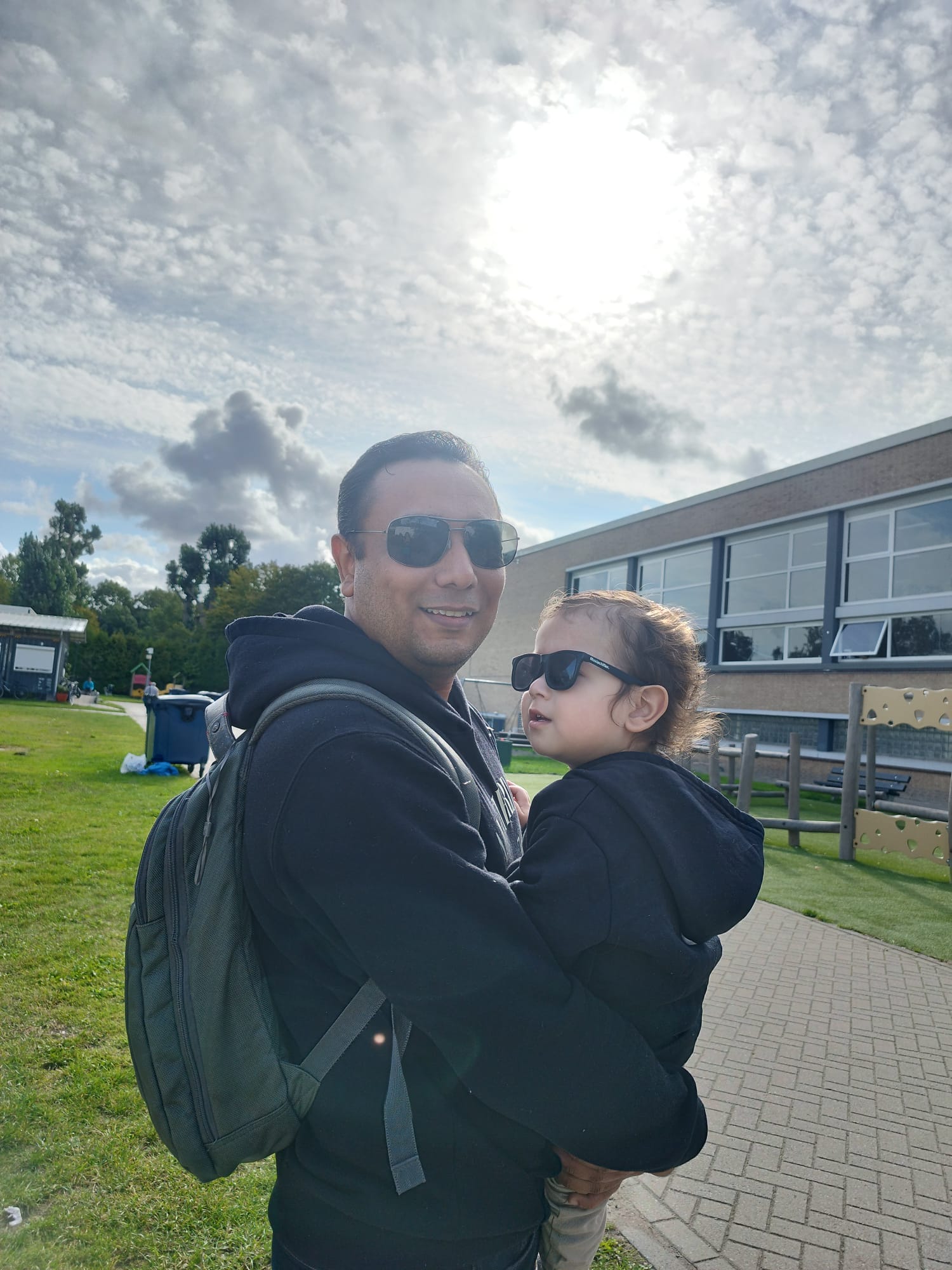
Seedword begins in the mud of Amsterdam. My son’s hand, native to this land from his very first breath, plants a Dutch bulb into the cold Northern soil. Our Colombian hands accompany him, and in that gesture, I mix the coffee of my origin with the earth that witnessed his birth. I do not attempt to give him a foreign homeland; I affirm his own. This planting is our way of founding a new home: letting the warmth of my memory fertilize the ground he inhabits, so that when the flower blooms in April, we know it is not just spring, but belonging.
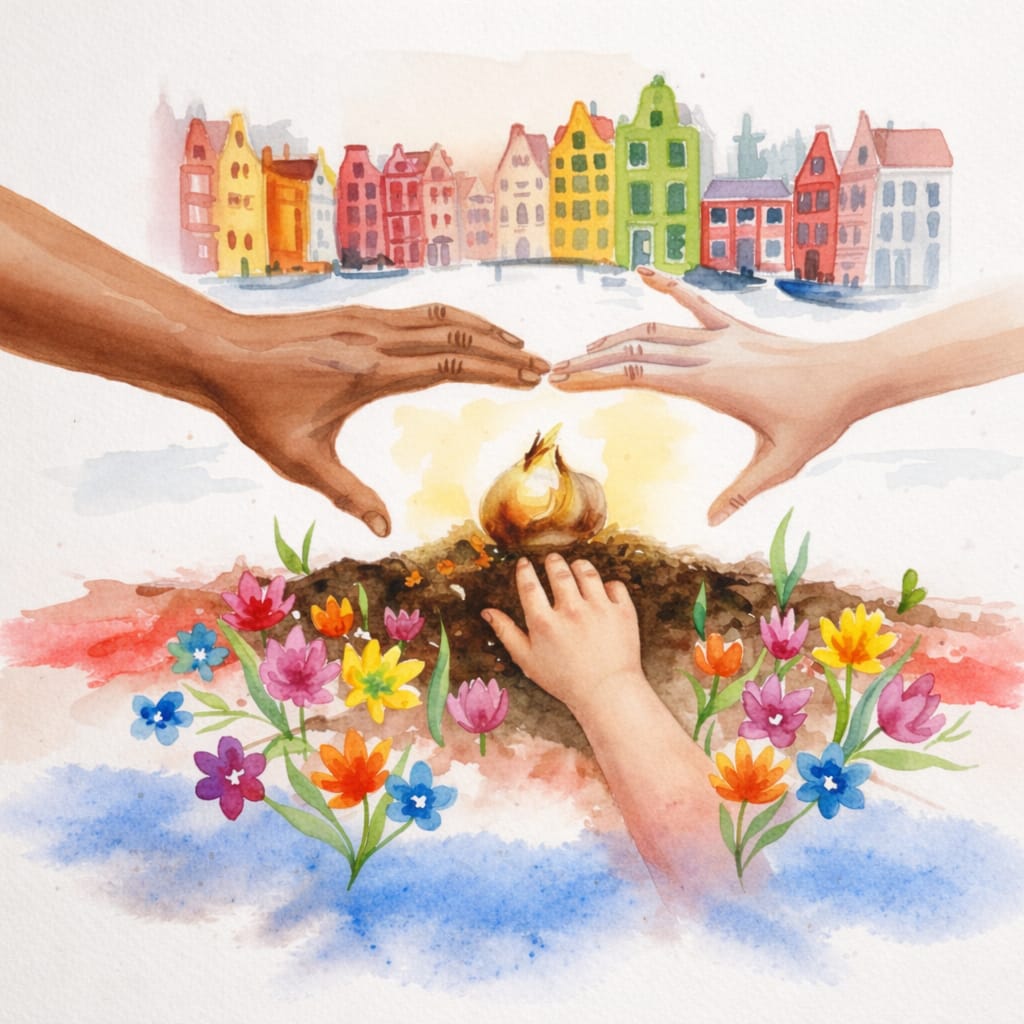
Founding a Home in the Mud of the North
I come from a land where time is a straight line, a perpetual midday that repeats with the stubbornness of the sun over the Andes. Facing a blank page here in Amsterdam, I feel a kind of sensory illiteracy that only exile can impose. In Colombia, nature is an inheritance given freely, an abundance that demands neither patience nor forgiveness. There, green is a state of siege, and life does not need to be reborn because it never stops. Writing about spring as a child of the tropics is an almost impossible act of translation. While the European receives it as the relief of the survivor, for me it is the mystical awe of one who witnesses the resurrection of matter.
My biological memory does not recognize the code of the bulb sleeping beneath frozen soil. My instincts respond to rains that wash away the dust, not to ice that arrests the pulse of the world. This absence of seasons has made me a chronological orphan, forced to invent my own calendar to avoid dissolving into the mist of the canals.
That personal winter, which began with my migration, has finally found an unexpected harbor: the gaze of my son. At two years old, he is the rightful inhabitant of this delta. His lungs have drawn in the sharp air of the Netherlands from his very first breath, and his eyes do not see January’s gray as a deficiency but as the natural prelude to color. Here, my nostalgia falters. My son is not a transplant. He is a native root.
He does not need me to bequeath a distant homeland he has never walked, nor to translate a language he does not inhabit in his play. His identity is the soil beneath his feet, and my duty as a psychologist, writer, and father is not to make him look back toward an origin that does not belong to him but to teach him to sanctify the land where he has chosen to flourish. For this reason, I reject conventional rituals and have decided to found for us Seedword (Zaai-woord), a liturgy of belonging that joins Dutch technique with the intentional potency of Andean thought.
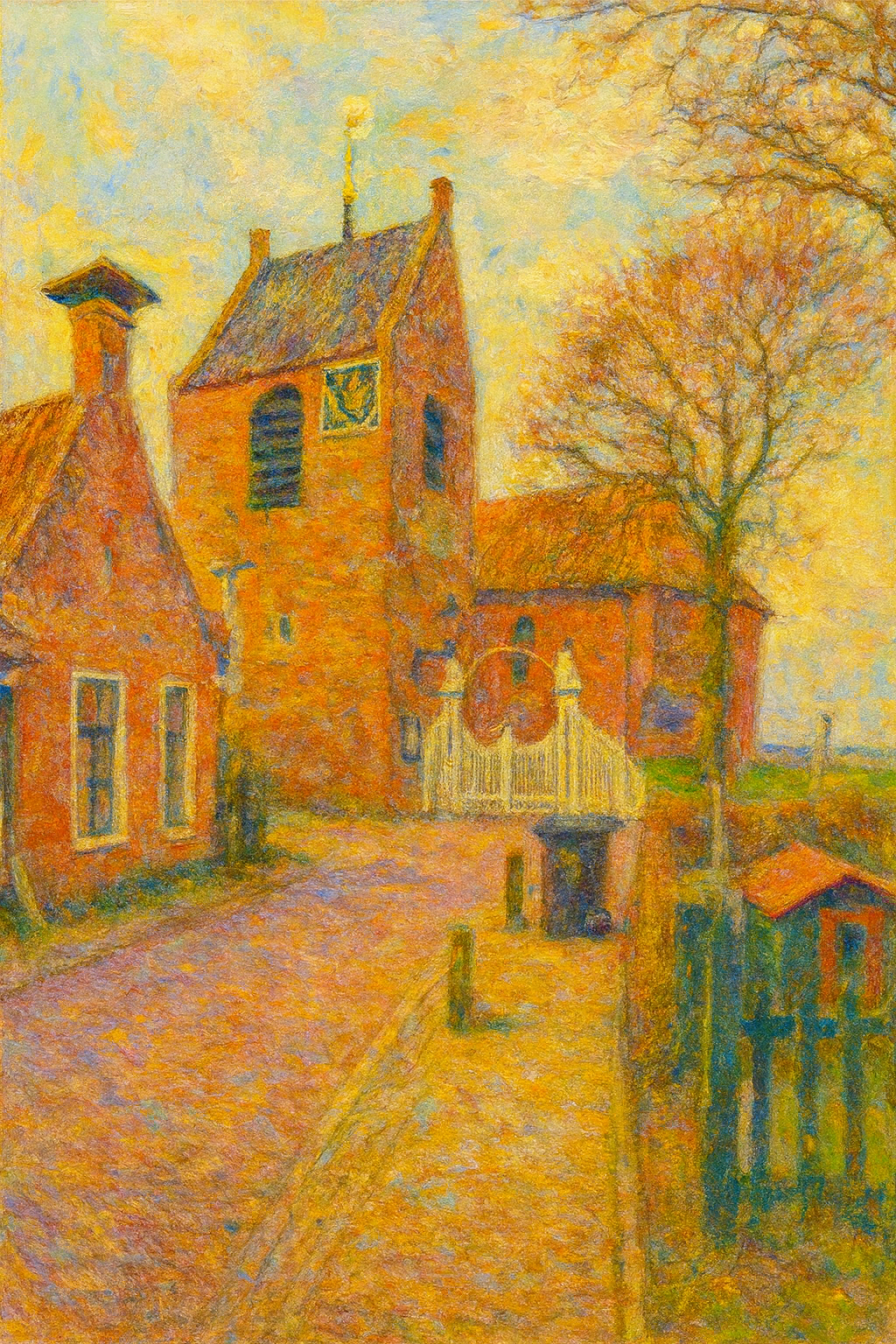
Typical Dutch village - digital drawing Alexander Fontanilla
The ritual Siembrapalabra
The ritual begins in the simplicity of mud. In the Netherlands, planting is often a mechanical act, a cultural inertia performed without ceremony. My contribution, the essence I bring from my Colombian being into this Dutch soil, transforms biological fact into a spiritual founding act. I bring my son to the moist earth of Amsterdam and hand him a bulb, that dry and seemingly lifeless object that holds the secret of the narcissus. His two-year-old hands dig the hole in the city’s dark substrate. It is there that the ritual reveals its true sociological dimension. We do not merely bury a bulb. Into that hole, I mix the remnants of the coffee I drank that morning, a residue of my own energy and origin, now serving as fertilizer for his present. It is the perfect metaphor for our coexistence. My history—the coffee, the warmth, the inheritance—does not seek to turn him into something he is not but to enrich the soil where he, like a Dutch flower, will grow stronger.
While his small fingers cover the seed, I perform the densest part of our tradition. I name his right to this land. I speak to his ear with the conviction of one who knows that words are a man’s true roots. I tell him that the cold is his, that the mud is his home, that the force of the North Sea flows through his veins. I tell him, too, that I love the freedom of his hair when the wind of the polders stirs it, for that air no longer pushes him outward but recognizes him as part of the landscape. The flower that will bloom in April is proof that life always finds a way to be reborn in Amsterdam.
This act of Seedword is my way of entering his world, of learning spring itself through his childlike wonder. My son is the bridge. He places his body into the Amstel, and I offer the intention that the pragmatism of the North sometimes forgets. I teach him that nature is not something that merely happens outside but a contract of patience we sign with time, a moral lesson against the rush of digital immediacy.
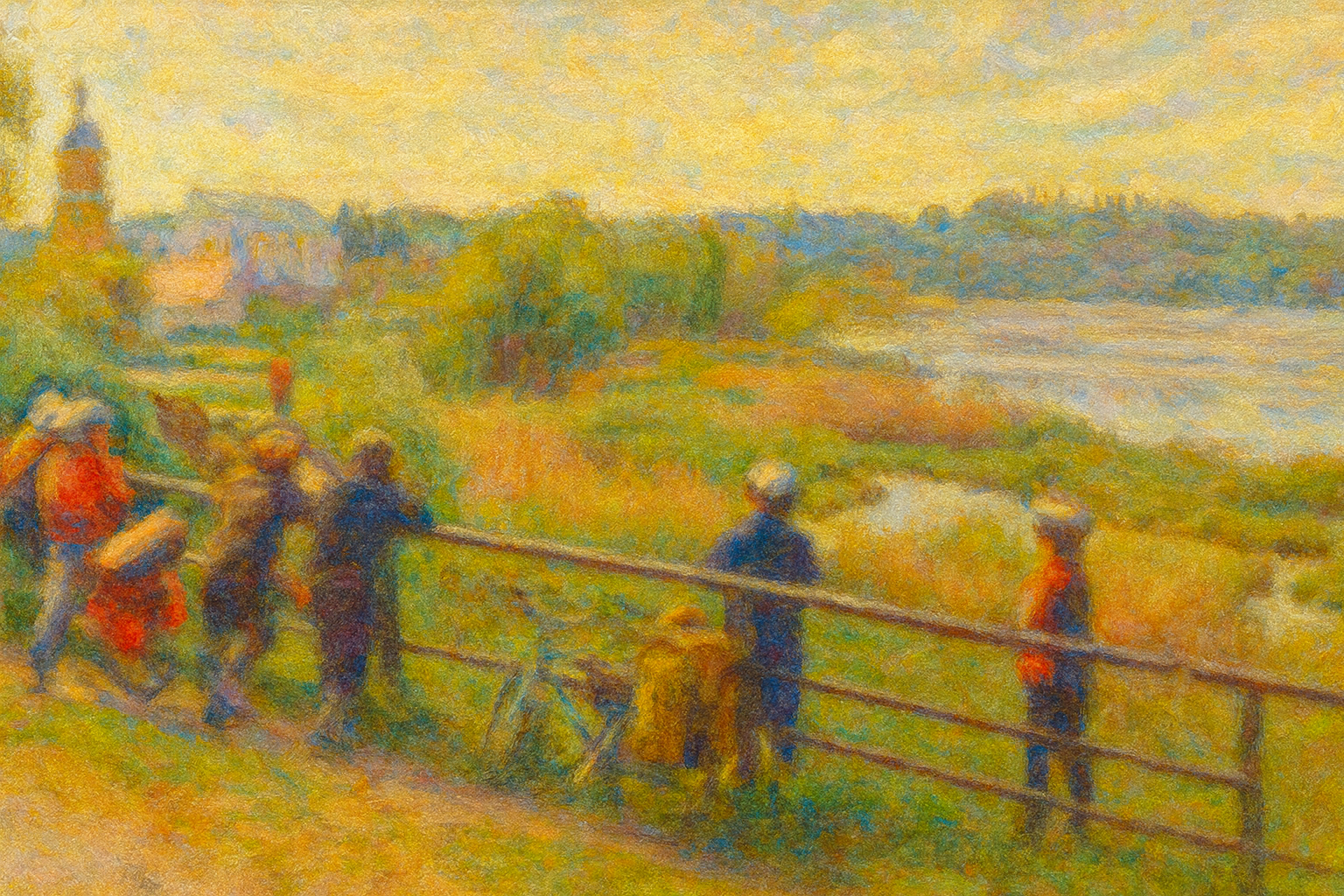
Reizen - digital drawing Alexander Fontanilla
In the end, this new family ritual has revealed to me a truth that only fatherhood in exile can grant. I am not a man divided between two worlds but a privileged witness to a synthesis. My son is the master of this garden, and I am the guardian of the memory that ensures his growth is not an accident of climate but an act of will. Spring in Amsterdam is no longer a foreign season to me. It is the exact moment when the coffee of my origin and the mud of his birth embrace beneath the soil, giving rise to a color we can finally call our own. In every sprout that breaks the ground in April, I read confirmation that we have ceased to be strangers, becoming the first generation of a new story, one where hope is not an abstract idea but a flower my son helped awaken.

Gerelateerde artikelen
audio, Beeldende Kunst, Inter-Culturele Rituelen voor Wereldburgerschap, Muzische expressie, Verslag, Video
-
Beeldende Kunst, Dichtkunst, Inter-Culturele Rituelen voor Wereldburgerschap

Beeldende Kunst, Beschouwing, Praktijken van wereldburgerschap